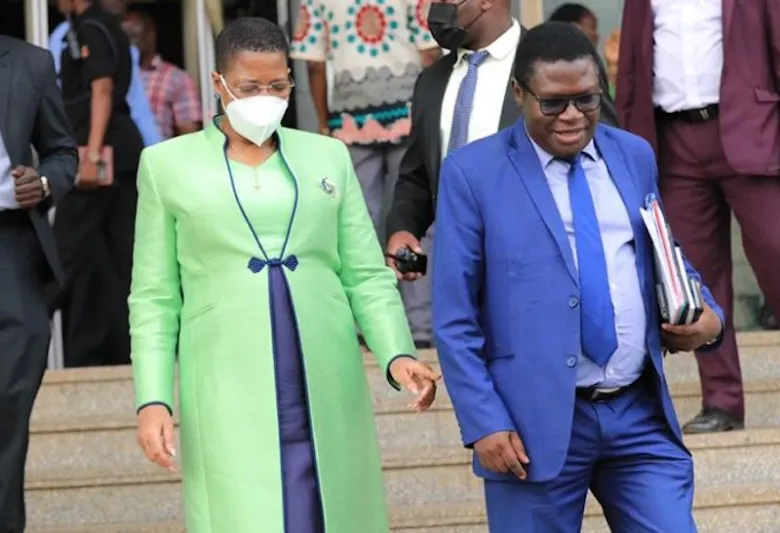
Uganda’s 12th Parliament Speakership Race: Anita Among Consolidates NRM Backing as Norbert Mao Sparks Debate
The race for the Speakership of Uganda’s 12th Parliament has exposed deep but measured tensions inside the ruling National Resistance Movement (NRM), with incumbent Speaker Anita Among emerging as the apparent beneficiary of a tightening party consensus.
What began as a speculative suggestion by Norbert Mao that the Speakership should be open to broader contestation has evolved into a wider debate about power, party discipline and institutional control in Uganda’s legislature.
Mao’s Remarks Trigger Swift NRM Response
Mao, a longtime opposition figure and president of the Democratic Party, raised the prospect of a more competitive Speakership contest during recent media interviews. His comments quickly drew reactions from pro-NRM voices, who defended Among’s record and described her as a “steady hand” at a politically sensitive time.
Several legislators publicly warned against what they termed “destabilising experiments,” signaling resistance within the ruling party to any abrupt leadership shift in Parliament.
Although senior NRM officials stopped short of issuing formal endorsements, repeated calls for “unity” and “discipline” were widely interpreted as indirect support for Among’s continuation in office.
Speakership as a Strategic Power Centre
The Speakership of Parliament in Uganda has evolved beyond a routine procedural role. Under the Constitution, the Speaker is tasked with safeguarding parliamentary independence, presiding over debate and ensuring fairness across party lines.
In practice, however, the office has become a strategic pivot within Uganda’s semi-dominant party system. Control over agenda-setting, committee assignments and internal discipline gives the Speaker substantial influence over legislative outcomes.
As a result, Speakership elections often reflect internal recalibration within the ruling party rather than purely open institutional contests.
Mao’s Bid: Reformist Credentials, Political Constraints
Norbert Mao brings significant political experience to any potential contest. A lawyer by training and former district chairperson, he has built his career around constitutional reform, governance advocacy and decentralisation.
However, his recent rapprochement with the ruling establishment has complicated his positioning. Supporters frame it as pragmatic bridge-building in a polarised environment. Critics question whether it blurs the line between opposition identity and ruling-party alignment.
Any Mao candidacy would therefore hinge not only on parliamentary arithmetic but also on whether entrenched NRM networks view him as reinforcing — rather than unsettling — existing power structures.
Lessons From the Oulanyah–Kadaga Contest
Uganda’s previous high-profile Speakership battle between Jacob Oulanyah and Rebecca Kadaga remains a key precedent.
That contest exposed factional undercurrents within the NRM, including regional alignments and generational tensions. It also underscored how executive preference can shape parliamentary outcomes without formally overriding constitutional procedures.
The episode reinforced a broader political reality: while Speakership elections are procedurally democratic, viable candidacies are often structured by internal party consensus.
Anita Among and the Politics of Consolidation
Since assuming office, Anita Among has transitioned from being perceived as a transitional figure to becoming a central actor within the NRM’s power architecture.
Her leadership style — described as assertive and disciplined — has helped maintain caucus cohesion and align Parliament closely with the government’s legislative programme. Supporters argue that her tenure reflects stability and institutional reliability, qualities that carry weight within a party that prioritises predictability.
Unlike past contests that pitted insiders against one another, a Mao challenge would confront an incumbent whose influence is still consolidating across party networks.
Museveni’s Preference for Stability
President Yoweri Museveni has long emphasized institutional continuity and internal discipline within the ruling party. While executive preferences do not formally dictate parliamentary votes, they often shape the boundaries of acceptable competition.
From this perspective, the Speakership — a key institutional lever — is unlikely to be left to unpredictable contestation.
What the 12th Parliament Speakership Race Reveals
As Uganda prepares for its 12th Parliament, the Speakership contest has become more than a procedural vote. It now serves as an early indicator of how power will be negotiated and consolidated within the NRM.
Anita Among represents continuity and embedded incumbency. Norbert Mao symbolizes negotiated repositioning and broader contestation. Yet Uganda’s dominant-party architecture has historically favored consolidation over experimentation.
Should a contest formally materialize, analysts suggest the decisive negotiations are likely to occur behind closed doors within ruling-party structures rather than on the parliamentary floor.
Ultimately, the Speakership race offers a window into the evolving dynamics of Uganda politics — revealing not just who may preside over Parliament, but how authority is structured and sustained within the state.
