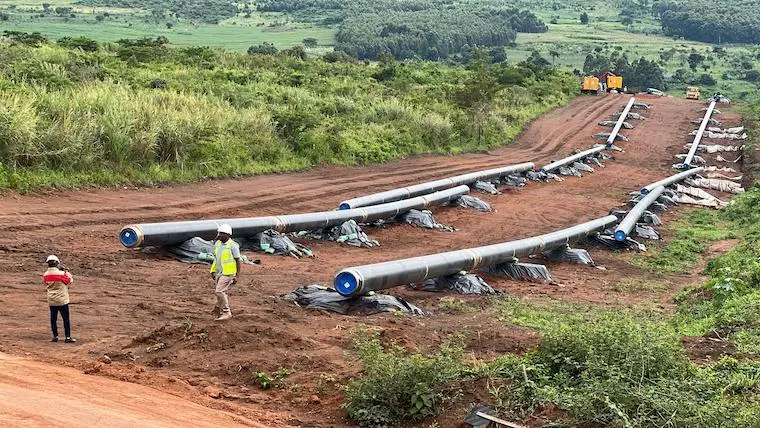
Oil Pipeline Being Laid as Uganda’s First Oil Revenues Expected in 2027, PAU Warns
Uganda’s long-awaited oil project has taken a major step forward with the continued laying of the East African Crude Oil Pipeline (EACOP). However, despite growing excitement ahead of commercial oil production, the Petroleum Authority of Uganda (PAU) has cautioned Ugandans that first oil revenues may only be realised in 2027, not 2026 as previously expected.
Speaking at the opening of the 6th Annual National Content Conference in Kampala, PAU Executive Director Ernest Rubondo explained that while oil production from the Tilenga and Kingfisher fields is scheduled to begin in mid-2026, revenue will not flow immediately.
Why Uganda’s First Oil Money May Arrive in 2027
Rubondo emphasised that earnings will only be generated after the crude has been processed, transported through EACOP, exported to the global market, and finally paid for.
“Many people talk about first oil but have not drilled down to what first oil actually means,” Rubondo noted, urging the public to avoid assuming that revenue will arrive the moment oil begins to flow.
He clarified that the crude must first pass through central processing facilities before reaching the official delivery point, the stage at which government can declare it ready for sale.
Once inside the 1,443-kilometre pipeline, the oil will take two to three months to reach the port of Tanga in Tanzania. It is at Tanga—when the oil is loaded onto ships—that ownership changes and revenue is realised.
“For some people, first oil is when it is on a ship and the money has come in. First oil has those four specific phases,” he added.
Rubondo urged Ugandans to understand that from a financing and banking point of view, first oil revenue naturally comes months after production begins.
Government Maintains First Oil Will Be Achieved in 2026
Despite PAU’s caution, State Minister for Energy, Opolot Okasai, reaffirmed that the government considers 2026 as Uganda’s “first oil” year—defined as the start of crude flow from the Tilenga and Kingfisher projects.
He encouraged Ugandans to position themselves for the vast economic opportunities ahead, especially as the country transitions from infrastructure development to full production.
“As we enter the operations phase, opportunities for Ugandan participation are immense,” Okasai said, citing projected annual operating expenditures exceeding $8 billion over the next 20–25 years.
These funds will support long-term contracts in engineering, manufacturing, equipment supply, ICT, health and safety, logistics, chemicals, and specialised oilfield services.
Oil Reserves Updated to 6.65 Billion Barrels
Minister Okasai confirmed updated national oil estimates, revealing that Uganda now holds 6.65 billion barrels in resources, with 1.65 billion barrels economically recoverable. Production is expected to reach 230,000 barrels per day, making Uganda a major new oil producer in East Africa.
However, he emphasised that the long-term success of the sector depends on building local expertise.
“How do we ensure this resource becomes a catalyst for national prosperity for generations to come?” he asked, urging Ugandans to acquire key technical skills for the next 25 years of operations—ranging from pipeline inspection to digital engineering, geoscience, finance, and HSE.
New Policies to Boost Local Participation
Okasai revealed that Cabinet has approved the National Oil Policy 2025, which prioritises increasing national petroleum reserves and expanding PAU’s regulatory mandate to include downstream operations such as fuel stations.
Additionally, a bill establishing the National Content Fund is before Cabinet. The Fund will offer affordable, patient capital to support Ugandan contractors competing in the oil and gas sector.
“Now that the sector is greatly de-risked, aggressive investment promotion in exploration will be a key government priority,” he said.
Conclusion
With the oil pipeline steadily advancing and production set for 2026, Uganda is nearing a historic milestone. However, according to the Petroleum Authority, actual oil revenues may only be realised in 2027 due to the complex export and payment process.
Still, government remains optimistic and is urging Ugandans to prepare for massive economic opportunities as the country transitions into full-scale oil production.
