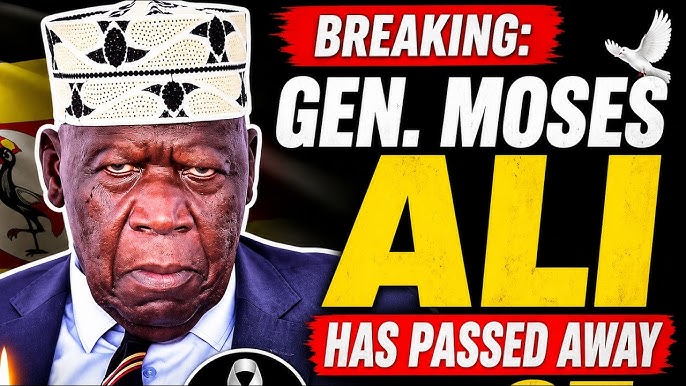
Gen. (Rtd) Moses Ali Dies at 87 After Decades of Military and Political Service
KAMPALA, Uganda — Gen. (Rtd) Moses Ali, one of Uganda’s longest-serving military commanders and politicians, has died at the age of 87, family members and government sources have confirmed.
Ali died at approximately 4:25 p.m. on Saturday at Nakasero Hospital, according to a family member who spoke on condition of anonymity because she was not authorised to issue an official statement.
Family members were reportedly gathering at the hospital as preparations for an official announcement got underway. A source in the Office of the Prime Minister also confirmed the death, saying Prime Minister Robinah Nabbanja was expected to formally announce the news on behalf of the government.
Former Health minister and Soroti Municipality MP Capt. Mike Mukula also confirmed Ali’s death in a condolence message shared on X.
Earlier in the week, several of Ali’s children, including family members who had travelled from abroad, gathered at Nakasero Hospital for a private meeting following his admission.
A five-decade military and political career
Gen. Moses Ali leaves behind a complex and influential legacy in Uganda’s military and political history. His public career spanned more than five decades, during which he served under successive governments, led a rebel movement, participated in peace negotiations and later became one of Uganda’s longest-serving Cabinet ministers.
Born on April 5, 1939, in Meliaderi village in present-day Adjumani District, Ali joined the Uganda Army in the 1960s and rose through the military ranks.
Following the 1971 coup that brought Idi Amin to power, Ali became one of Amin’s senior military commanders and held several ministerial positions, including Minister of Provincial Administration and Minister of Finance.
After the fall of the Amin government in 1979, Ali went into exile before later emerging as the leader of the Uganda National Rescue Front (UNRF), a rebel movement that fought the second Milton Obote government in the West Nile region.
Following peace negotiations with President Yoweri Museveni’s government after 1986, the UNRF was integrated into the National Resistance Army (NRA), now the Uganda People’s Defence Force (UPDF).
Ali was subsequently commissioned as a Major General, marking the beginning of a new chapter in his military and political career.
Long-serving Cabinet minister
Over the years, Ali held several senior government positions, including Minister of Tourism, Wildlife and Antiquities; Minister of Youth, Culture and Sports; and Minister of Disaster Preparedness and Refugees.
He also served as Third Deputy Prime Minister, First Deputy Prime Minister and, most recently, Second Deputy Prime Minister and Deputy Leader of Government Business in Parliament.
His military career also advanced significantly, with his promotion to Lieutenant General in 2003 and later to full General in 2012.
Ali eventually retired from active military service but remained involved in elective politics.
He was widely credited with playing a key role in efforts to restore peace in the West Nile region through negotiations that led to the integration of former rebels into the national army.
Political career and final years in public service
Throughout Uganda’s transition from military rule to constitutional governance, Ali remained a prominent political figure.
He represented East Moyo County before later becoming Member of Parliament for Adjumani West County.
In the 2026 general elections, Ali retained the Adjumani West parliamentary seat on the National Resistance Movement (NRM) ticket.
However, following the elections, President Museveni did not reappoint him to Cabinet, bringing to an end more than five decades of service in successive governments.
His son, Ali Siraj, was subsequently appointed Minister of State for Works.
Funeral arrangements and details of the official burial programme are expected to be announced after the family and government issue formal statements.
