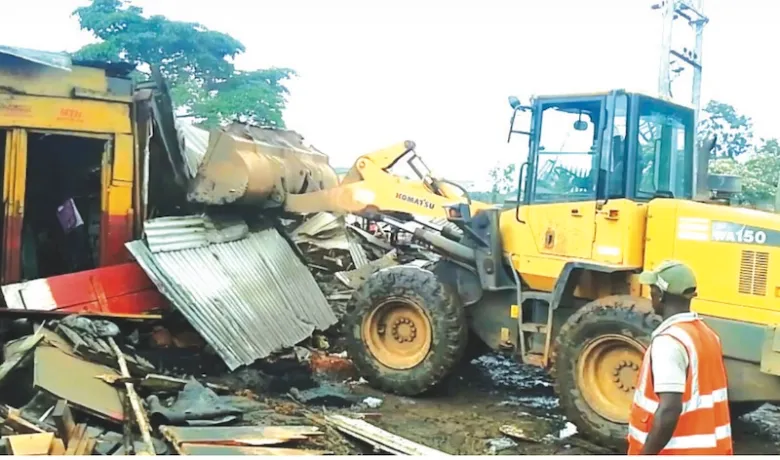
The demolition of roadside kiosks in Bulindo and Kitukutwe has left dozens of traders struggling to rebuild their lives after losing businesses that had supported their families for years.
What were once vibrant trading centers filled with food vendors, grocery sellers, and small-scale entrepreneurs have been reduced to piles of timber, twisted iron sheets, and scattered merchandise following a government-led exercise targeting structures built within road reserves.
For many traders, the demolitions have not only wiped out their investments but also destroyed their primary source of income.
Among those affected is Mama Vanessa, a longtime trader in Bulindo who now sells a few tomatoes, onions, and household items by the roadside after her kiosk was demolished.
Before the demolition, her small business provided enough income to pay school fees, buy food, cover rent, and support both her children and grandchildren.
“I started with only Shs75,000 because I wanted to stop depending on relatives,” she said. “The business grew over time, and on good days I could make sales worth Shs250,000. Now everything is gone.”
She says customers are no longer buying her products because they are exposed to dust and direct sunlight from ongoing road construction works.
Like many small-scale entrepreneurs across Uganda, Mama Vanessa built her business gradually through daily savings and hard work. However, government directives aimed at clearing road reserves brought her progress to an abrupt end.
The situation is similar for Atuhaire, popularly known as Mukiga, whose kiosk supplied household necessities to residents in the area.
Standing beside pieces of timber salvaged from her demolished structure, she recalls investing nearly Shs2 million in building her business.
“I used almost all my savings to set up that kiosk,” she said. “Everything I invested has been lost.”
Atuhaire explained that her business not only supported her family but also helped meet the daily needs of residents who relied on nearby kiosks for groceries and basic household items.
The loss has become even more devastating because she was using the business to repay loans and support her family after her husband lost his job.
“There is no money for school fees, yet the children are expected to return to school soon,” she said.
Many traders claim they received little notice before the demolitions and were not offered compensation or alternative trading spaces.
The roadside kiosks had become an important part of the local economy, serving residents with affordable goods and services while creating employment opportunities for hundreds of people.
According to Uganda’s Ministry of Finance, Planning and Economic Development, Micro, Small and Medium Enterprises (MSMEs) play a critical role in economic growth, employing more than 2.5 million people and contributing significantly to the country’s manufacturing output and Gross Domestic Product.
Patricia Nalubega, who operated a roadside chips stall, says she used her business income to pay rent and support family members living in her village.
“Business was not perfect, but at least I earned something every day,” she said. “Now I don’t know where to start from.”
Nalubega fears she may soon be unable to pay rent and says many traders are facing severe financial hardships.
She believes the government should establish permanent markets for affected traders rather than simply demolishing their workplaces.
“We want designated places where we can continue working and supporting our families,” she said.
For Douglas, a chapati vendor in Kitukutwe, the demolition erased years of effort in a matter of hours.
His small kiosk attracted regular customers seeking breakfast and evening snacks, allowing him to earn enough money for rent and daily expenses.
Today, he operates informally and constantly fears being removed again.
“Sometimes I return secretly with a small stall, but when I hear council officials are coming, I have to leave immediately,” he said.
Residents say the demolitions have also affected access to affordable goods and services, forcing customers to travel longer distances for basic necessities.
Some kiosks reportedly doubled as both business premises and living spaces for struggling traders who could not afford separate accommodation.
Local resident Musa said several people became homeless after the structures were demolished.
“Some traders were living inside those kiosks. Now they have nowhere to stay and some have returned to their villages,” he said.
As road construction continues across Bulindo and Kitukutwe, the remains of demolished kiosks stand as a reminder of the difficult balance between urban development and protecting livelihoods.
While authorities maintain that the exercise is necessary to enforce road reserve regulations and improve infrastructure, affected traders say the demolitions have left them facing hunger, debt, homelessness, and uncertainty about the future.
For many families, the loss represents more than a demolished structure—it marks the collapse of years of hard work, investment, and hope for a better life.
