Lumbuye Row Escalates as Hundreds March on Turkish Embassy in Kampala
PLU protesters demand Fred Lumbuye’s extradition as Uganda-Turkey tensions deepen
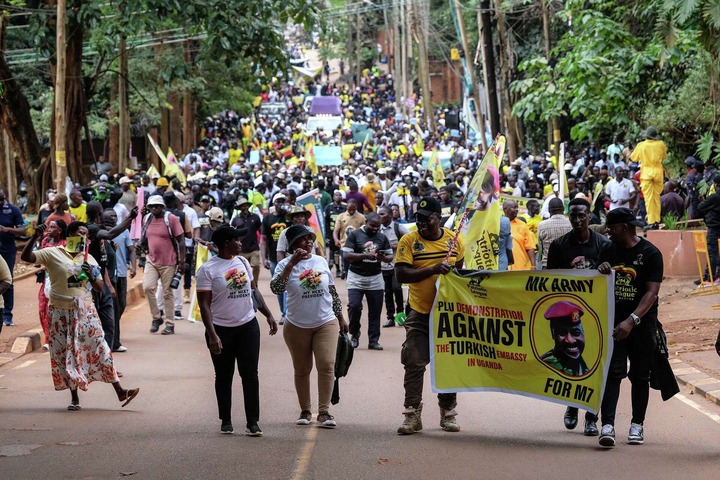
KAMPALA, Uganda — Hundreds of Ugandans marched to the Turkish Embassy in Kampala on Friday demanding the extradition of political commentator Fred Lumbuye, turning a months-long dispute between Uganda and Turkey into a major public confrontation.
The demonstration, organized by the Patriotic League of Uganda (PLU), centered on Lumbuye, a Ugandan government critic who has lived in Turkey for years and whose social media commentary on Ugandan politics has attracted a substantial following.
Ugandan authorities and PLU officials accuse Lumbuye of activities including harmful propaganda, incitement and cybercrimes. Those are allegations, and it was not possible for the Associated Press to obtain comment from Lumbuye on the claims. His legal status in Turkey also remains unclear.
The protest brought together a politically charged crowd outside the diplomatic mission as demonstrators called on Ankara to return Lumbuye to Uganda.
“We have gathered here today not as enemies of Turkish people but as patriots of Uganda who are deeply disappointed,” PLU Secretary-General Fadil Twalla told protesters, according to AP.
Twalla accused Lumbuye of using his presence in Turkey to continue criticizing Uganda’s national leadership.
The demonstration was also marked by a confrontation with security forces. Reuters reported that PLU members scuffled with riot police as they marched toward the Turkish Embassy.
A Dissident at the Center of a Diplomatic Dispute
At the heart of the controversy is Lumbuye’s ability to reach Ugandan audiences from outside the country.
His political posts have attracted thousands of viewers, providing him with a platform that critics of the Ugandan government inside the country may not have.
For PLU supporters, that influence has made Lumbuye a central target in their campaign for his return.
Ugandan officials have previously linked him to allegations involving online content and public incitement. However, the allegations should not be treated as established criminal findings without a court determination.
Lumbuye’s absence from Uganda has also complicated the government’s efforts to pursue the case.
The dispute now rests partly on what Turkish authorities decide to do about his status and any request from Uganda for his return.
Muhoozi Kainerugaba Turns Up Pressure on Ankara
The protest comes after months of increasingly public criticism of Turkey by Gen. Muhoozi Kainerugaba, Uganda’s Chief of Defence Forces and chairman of the PLU.
Kainerugaba, the eldest son of President Yoweri Museveni, has repeatedly criticized Turkish authorities over Lumbuye and previously backed plans for demonstrations outside the embassy.
Those demonstrations were postponed several times as diplomatic efforts continued, according to AP.
The dispute escalated further earlier this year when Kainerugaba made a series of demands on social media. AP reported that he demanded $1 billion from Turkish authorities, alongside an unusual demand involving Turkey’s “most beautiful woman,” while threatening consequences for diplomatic relations.
The comments added an extraordinary dimension to an already sensitive dispute between the two countries.
The Political Stakes in Uganda
The Lumbuye controversy is unfolding as Kainerugaba assumes a more prominent role in Uganda’s political life.
Kainerugaba has said he intends to seek the presidency in 2031, when his father’s current term is due to expire.
The PLU has been mobilizing signatures in what it describes as a show of support for Kainerugaba’s political ambitions, according to bbc media.
That has placed the dispute with Turkey within a broader domestic political context.
The embassy demonstration was therefore not simply a protest over an individual Ugandan living abroad. It also showcased the growing political activity surrounding the PLU and its chairman.
At the same time, claims about Kainerugaba being Uganda’s “de facto leader” are assessments reported by bbc media rather than a formal constitutional designation.
Why Turkey Matters to Uganda
The disagreement over Lumbuye is taking place against a wider relationship that extends beyond the extradition dispute.
Uganda and Turkey have interests in regional security, trade and infrastructure, while Turkey has become increasingly active in the Horn of Africa.
One particularly important area is Somalia, where Ugandan troops have for years supported the federal government in its fight against al-Shabab militants.
Turkey has also expanded its role as a security partner in Somalia.
Ugandan analyst Angelo Izama, of the Fanaka Kwawote think tank, told AP that Turkey’s growing influence in Somalia has become an important factor in the regional relationship.
Uganda is expected to withdraw its troops from Somalia by August 2027, adding another major issue to the country’s evolving regional security calculations.
From Diplomatic Dispute to Street Protest
The decision to take the Lumbuye issue to the streets represents an escalation.
Rather than remaining a dispute between government officials and diplomats, the controversy has become a public political campaign.
PLU supporters now want Turkey to act on Uganda’s demand for Lumbuye’s return.
Reuters photographs from the September 18 demonstration showed protesters confronting riot police outside the Turkish Embassy, underlining the tensions surrounding the march.
The demonstration also highlights the difficult position facing Turkish authorities.
Any decision concerning Lumbuye could have implications for Uganda-Turkey relations, while refusing to act could leave the dispute unresolved and encourage further pressure from Kampala.
What Happens to Fred Lumbuye?
For now, Lumbuye remains in Turkey, and his precise legal status there is unclear.
Ugandan authorities say he is wanted over allegations involving harmful propaganda, incitement and cybercrime. PLU supporters are demanding that Turkish authorities facilitate his return.
But an extradition request does not automatically result in the transfer of a person from one country to another. Such cases can involve domestic law, judicial proceedings, immigration status and diplomatic considerations.
The public dispute therefore does not by itself establish that Lumbuye will be extradited.
It also leaves an unanswered question: will Turkey respond to Uganda’s demands, or will the dispute continue to deepen?
A Bigger Test for Uganda-Turkey Relations
The events outside the Turkish Embassy have transformed Fred Lumbuye’s case into something much larger than a dispute over one political commentator.
It now touches on freedom of political expression, online activism, extradition, diplomatic relations, regional security and Uganda’s evolving political landscape.
For the PLU, the immediate demand is clear: they want Lumbuye returned to Uganda.
For Turkish authorities, the issue involves decisions about a Ugandan national residing in Turkey and the country’s relationship with Kampala.
And for Uganda, the confrontation comes at a time when Gen. Muhoozi Kainerugaba is becoming increasingly prominent in national politics and the country’s regional security role continues to evolve.
The September 18 protest has therefore put the Lumbuye case firmly back at the center of Uganda’s domestic politics and its relationship with Turkey.
Whether the confrontation leads to diplomatic negotiations, further demonstrations or a formal decision on Lumbuye’s status remains to be seen.
For now, the protest has delivered a clear message from the PLU: the pressure on Turkey to address Uganda’s demand for Fred Lumbuye is not going away.
